The Playlist Meme
I thought, the
recent
playlist
meme on
ThoughtWorks blogs is pretty nice,
so I decided to blog the next ten random songs:
- Tom Waits—Don’t Go Into That Barn
- Incubus—Beware Criminal
- Bob Dylan—Tombstone Blues (Real Live)
- DJ Shufflemaster—Dawn Purple
- Coastal—Eternal
- Paradise Lost—Sell It To The World
- Offspring—Living In Chaos
- Manowar—Warriors Of The World United
- Pearl Jam—Jeremy
- Tobias Schmidt—Wronged
I’m pretty confident with that selection of music. I think it
represents my taste quite well.
Just for reference, the next five songs would be:
- Live—Pillar Of Davidson
- Die toten Hosen—Call Of The Wild
- Pearl Jam—Satan’s Bed
- Metallica—2x4
- Opeth—Demon Of The Fall
A loooong running meme, it seems to orginate from
berlinde
(which doesnt seem to date her entries…).
I wish everyone a Happy New Year!
NP: Tom Waits—Don’t Go Into That Barn
Nukumi2 0.1 is out!
Nukumi2 0.1 is out!
Proper announcement at
ruby-talk.
Merry blogging and a happy new year. :-)
NP: Bob Dylan—I Shall be Released
The Great Wave
Which picture could fit better to the current
situation?
NP: Pearl Jam—Love Boat Captain
Is this just another phase? earthquakes making waves
Trying to shake the cancer off? oh, stupid human beings
Once you hold the hand of love,… it’s all surmountable.
Push vs. Pull
Push me, pull me… or just pull me out.
— Pearl Jam, Push Me, Pull Me
Currently, there are three popular ways of parsing XML: The DOM, the
SAX and Pull APIs.
DOM is probably the most well known, and it did a great job showing
off XML’s slowness. This is because DOM reads the full XML into the
core as a tree structure. The nodes of the tree mainly consist of
Element nodes and Text nodes. DOM is very easy to use, but also
very inefficient. Ruby’s REXML is mainly used in the DOM mode;
although it’s API is rubyfied and made a lot nicer, the core idea is
the same: provide a tree structure to XML documents.
The downsides of DOM (and the complexity of implementation) turned out
pretty quickly, and soon the Simple API for XML (SAX) was
implemented in Java. SAX is a streaming API, the SAX parser scans
over the document and emits events. For example, the simple document
<doc>This is a <em>very</em> simple XML document.</doc>
emits these events (simplified):
start_element "doc"
text "This is a "
start_element "em"
text "very"
end_element "em"
text " simple XML document."
end_element "doc"
Usually, the program defines a new class whose methods get called by
the SAX parser.
SAX is very efficient (the API is quite like the Expat one, which
is well-known being the fastest XML parser on earth), but can be
amazingly complex to use. (Personally, I don’t have a hard time
with it—at least for easy stuff—, but there are people that don’t
like state machines.)
REXML also provides a SAX interface, which is quite fast, but of
course not like the real thing. If you want absolute performance, I
still can only recommend the Ruby Expat bindings. Though the
binding was not updated recently (my version is from 2002), it
runs like hell.
The last, and the IMO most interesting way to parse XML is a pull API.
As usual, the first implementation was written in Java (XPP1, I think)
and the API was only informally (i.e. by implementation) defined. The
XmlPull API changed that. For Java, there now exist a bunch of
XML pull libraries that can all be accessed using the same way.
REXML provides a Pull API, too; but has been marked experimental and
they don’t recommend production use. Besides, it has problems with
namepaces (which is true for REXML in general. :-/).
Although being technically one step lower than SAX, Pull APIs are much
more intuitive to program. The Pull API requires you to fetch each
event by yourself, therefore you don’t need a state machine as you can
simply get the next events when you need them, not when they arrive.
This can be shown best at a simple example:
My old homepage provided an index facility, where words marked in
idx and hidx (for hidden index) are aggregated into a special
page. I implemented the program first using REXML and its DOM API.
The page to link to can be found out getting the name attribute of
the page root node. I basically needed an index word to page hash.
Here is the parsing code:
doc = Document.new(File.open(f))
htmlfile = XPath.first(doc, "/page/@name").to_s
["//idx", "//hidx"].each { |xp|
XPath.each(doc, xp) { |child|
word = child.text.squeeze(" ").strip
index[word] ||= []
index[word] << htmlfile
}
}
This program was a total performance hog, and intolerable to run (for
me, at least). I rewrote it using expat:
class IdxParser < XML::Parser
attr_accessor :index
def initialize(encoding = nil, nssep = nil)
@save = false
@word = ""
@htmlfile = ""
end
def startElement(nsname, attr)
ns, name = nsname.split(";", 2)
if ns == $IDXNS && (name == "idx" || name == "hidx")
@save = true
@word = ""
elsif name == "page" && attr["name"]
@htmlfile = attr["name"]
end
end
def endElement(nsname)
ns, name = nsname.split(";", 2)
if ns == $IDXNS && (name == "idx" || name == "hidx")
@save = false
@word = @word.squeeze(" ").strip
@index[@word] ||= []
index[@word] << @htmlfile
end
end
def character(t)
@word << t if @save
end
end
This program works very fast, but it was a bitch to write and lots
longer, of course. For complex formats, SAX gets darn complicated,
trust me.
Finally, the elegant pull API (this implementation uses REXML’s Pull
API which has a bit weird API):
parser = REXML::Parsers::PullParser.new(io)
htmlfile = nil
parser.each { |event|
if event.start_element? && event[0] == "page"
htmlfile = event[1]["name"]
end
if event.start_element? && event[0] =~ /idx:h?idx/
word = parser.squeeze(' ').strip
(index[word] ||= []) << htmlfile
end
}
Since the REXML Pull API didn’t fully satisfy my needs, I decided to
rewrite a pull parser for ruby from scratch (Heck, I even spent a day
hacking it in pure Ruby, but soon gave up.), based on the Pull API
exposed by libxml2. I think above example will read something like
this when it’s done:
parser = FastPull.new(io)
htmlfile = nil
while parser.pull
if parser.start_element? && parser.name == "page"
htmlfile = parser.attributes["name"]
end
if parser.start_element? && parser.name =~ /{#{$IDXNS}}h?idx/
word = ""
while parser.pull.text?
word << parser.text
end
(index[word.squeeze(' ').strip] ||= []) << htmlfile
end
}
Now, you have the easiness of DOM and the speed of SAX. :-) (And I can
look at XML again.)
NP: Pearl Jam—Push Me, Pull Me

Ruby Christmas
My Christmas post to ruby-talk:
s="IyBUaGFua3MgZm9yIGxvb2tpbmcgYXQgbXkgY29kZ
S4KIwojIENvcHlyaWdodCAoQykgMjAwMiAgQ2hyaXN0a
WFuI E 5 l d Wtpc
mNoZ W 4 gP G N obmV
1a2l y Y 2hlb k B nbWF
pbC5 j b 20+CiM K I yBUa
GlzI H Byb2dyYW 0 gaXM
gZnJ l Z SBzb2Z0d2F y Z Tsge
W91I G NhbiByZWRpc3 R yaWJ
1dGU g aXQgYW5kL29yCi M g bW9k
aWZ5 I Gl0IHVuZGVyIHRoZ S B0ZX
Jtcy B vZiB0aGUgR05VIEdlb m VyYW
wgUH V ibGljIExpY 2 Vuc2
UuCg p T VERPVVQuc3lu Y y A9IH
RydW U KZDEsIGQyID0gM C 4xNS
wgMC 4 wNgpzID0gIk1lcnJ 5 IGNo
cmlz d G1hcywgLi4uIGFuZCB h IGhh
cHB5 I G5ldyB5ZWFyIgptID0gJ X d7LC
AuID ogISArICogMCBPIEB9CnUg P SAiI
CIgK i BzLnNpemUKCnByaW50ICJcci A gI3t
1fVx y IjsKCigwLi4ocy5z a XplL
TEpK S 50b19hLnNvcnRfYnkg e yByY
W5kI H 0uZWFjaCB7IHxyfAogIH N sZWV
wIGQ x CiAgbmV4dCBpZiBzW3JdID 0 9ICI
gIls wXQogIG0uZWFjaCB7IHxrfAo gICA
gdVt y XSA9IGsKICAgIHByaW50ICIgIC N 7dX1
cciI KICAgIHNsZWVwIGQyCiAgfQogIHV bcl0
gPSB zW3JdCiAgcHJpbnQgIiAgI3t1fVxyI g p9Cg
pzbG VlcCBkMgpwcmludCAiICAje3V9IVxyI jsKc
2xlZ X A gMwpwc m l udCA
iICA j e3V9IS A g LS1j
aHJp c z JcbiI7 C g ojIG
ZpbG x lciBzc G F jZSA
jIyM j I yMjIyM j I yMjI
yMjI y M j I yMjI
yMK";eval s.delete!(" \n").unpack("m*")[0]##
### Copyright (C) 2004 Christian Neukirchen
Ruby 1.8.2 is out!
NP: Heather Noel—Santa Came On A Nuclear Missile
A Koan on Diversity
The master asked the novice: “What should be prefered? A shower with
one knob, or a shower with two knobs?”
“The one with two knobs, of course, because it allows for greater
diversity during showering.”, the novice responded.
“Then you shalt receive the shower with two knobs: One knob for too hot
water, and the other one for too cold water.”, the master said.
Upon hearing this, the novice was enlightened.
NP: Bob Dylan—Someone’s Got A Hold Of My Heart
Merry Christmas!

Frohe Weihnachten, ein schönes Fest, und einen guten Rutsch ins neue Jahr
wünscht euch Christian Neukirchen
Merry Christmas and a Happy New Year!
NP: Die Roten Rosen—Merry X-Mas Everbody
Winterferien!
Endlich, die Winterferien sind da!
Da man (wie üblich) in der letzten Woche (außer einer Französisch- und
Mathe-KA) nix sinnvolles mehr gemacht hat, muss das auch dokumentiert
werden:
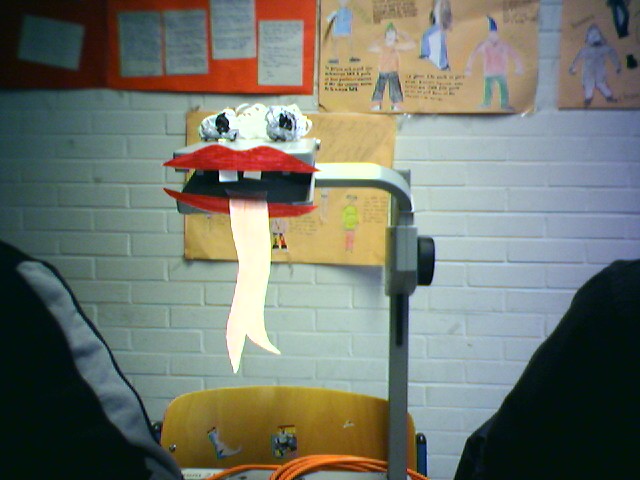
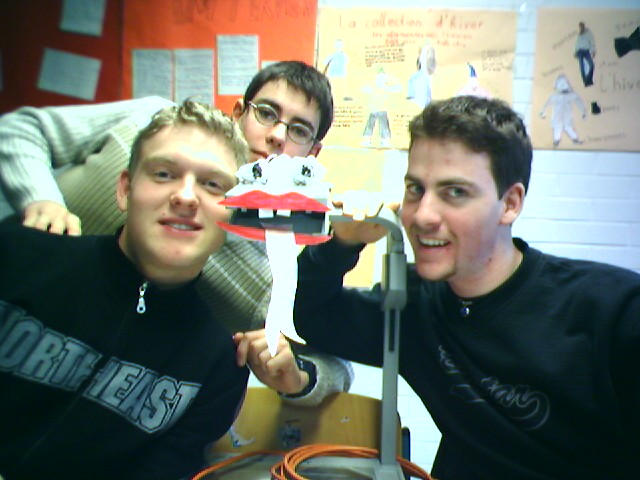
Am Freitag wurde ein Tageslichtprojektor als Drache verkleidet (meine
Fresse):
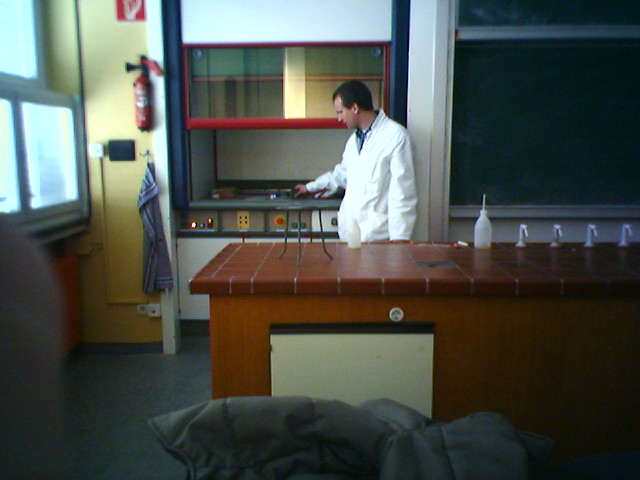
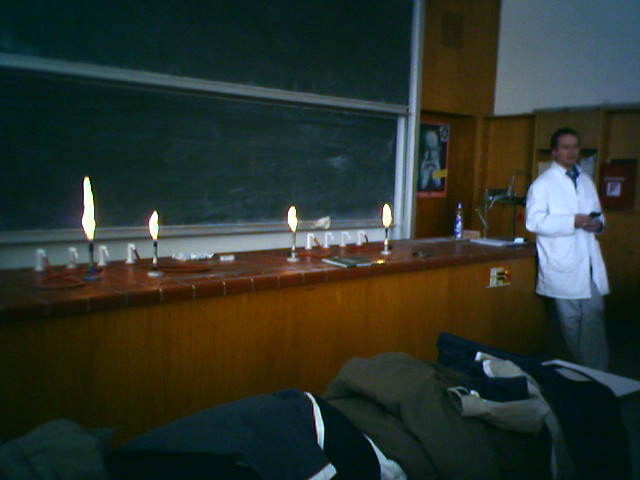
In Chemie haben wir einen Spitzer angezündet:
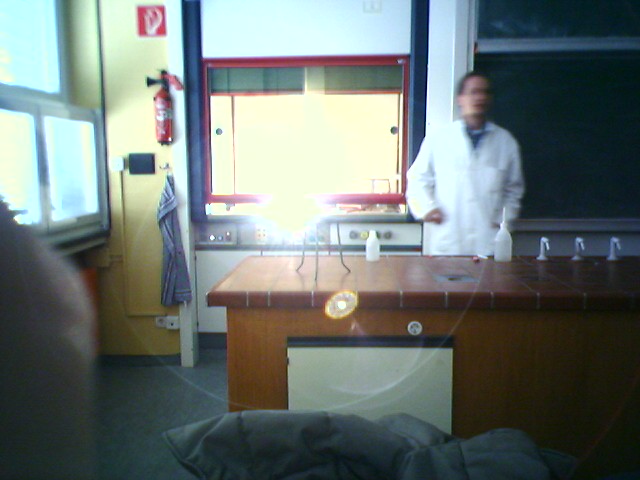
Außerdem gabs da auch vier Bunsenbrenner, weil ja 4. Advent war: (Man
beachte auch die Wodkaflasche auf dem Tisch…)
Schließlich, die letzten Quotes im Jahr 2004!:
Klima!
— Das ist mir zu allgemein.
— Lebensraum!
Bist du schön?
— Nein, … ähm JA!
Schwarz wie Zedernholz.
Ein Maulwurf zum anderen: “Was ist los? Du siehst du aufgewühlt aus!”
Keine Angst, nächstes Jahr gehts weiter!
Allen, denen von mir aus noch nichts frohes gewünscht wurde:
Frohe Weihnacht, frohes Chanukka und passt auf die Mauer auf!
NP: Die Roten Rosen—We Wish You A Merry Christmas
PowerPoint in schools
I just found PowerPoint Remix
by Aaron Swartz via del.icio.us, and this
“slide” I couldn’t leave behind unblogged (emphasis mine):
PowerPoint in schools
- disturbing!
must find replacement
- Good: teaching kids to smoke
- Better: close school, go to Exploratorium
- Best: write illustrated essay
NP: Bob Dylan—License To Kill
4. Advent
Soo, 4. (und letzter ;-)) Advent heute. Und pünktlich zur bald
folgenden Weihnachtszeit hat’s auch schon schön geschneit; der Schnee
bleibt sogar liegen. Wunderschöne Winterlandschaft draussen.
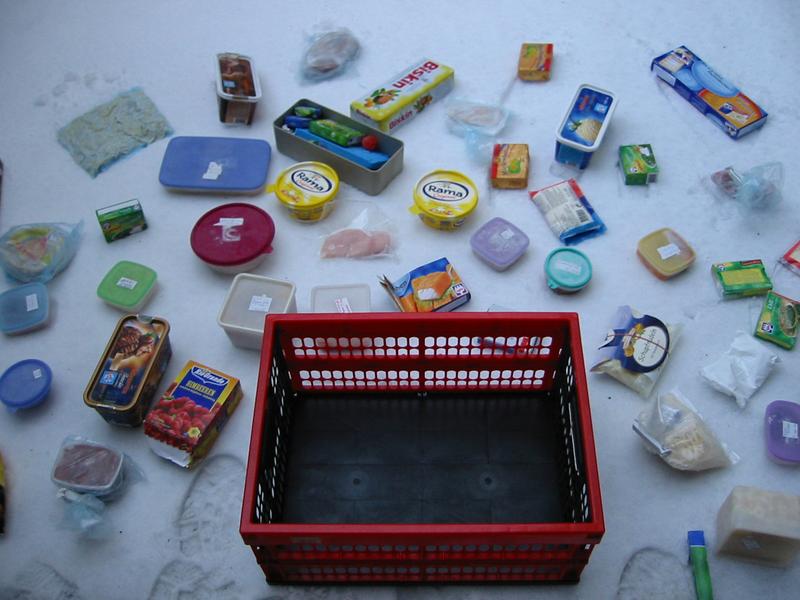
Als Nebeneffekt dessen haben wir heute den Gefrierschrank enteist.
Bilder gibt’s leider keine, aber dafür das von letztem Jahr nochmal:
Noch drei Tage Schule dieses Jahr. Der Schülergottesdienst ist
übrigens am Dienstag, damit sich die Schüler am Mittwoch in der ersten
nicht besaufen können…
NP: Pearl Jam & Neil Young—Truth Be Known
Songs And Artists That Inspired Fahrenheit 9/11
I just discovered this, IMO very felicitous, compilation of songs by
Michael More, called “Songs And Artists That Inspired Fahrenheit
9/11”.
Although I don’t fully agree with him in political ways (he has a
point though, for sure.), I think he has a good taste for music:
- I Am A Patriot—Little Steven & the Disciples of Soul
- Chimes Of Freedom (Live)—Bruce Springsteen
- With God On Our Side—Bob Dylan
- We Want It All—Zack de la Rocha
- Boom!—System Of A Down
- No One Left—The Nightwatchman
- Masters Of War (Live)—Pearl Jam
- Travelin’ Soldier—Dixie Chicks
- Fortunate Son (Live)—John Fogerty
- Know Your Rights—The Clash
- The Revolution Starts Now—Steve Earle
- Where Is The Love?—Black Eyed Peas feat. Justin Timberlake
- Good Night, New York (Live)—Nanci Griffith
- Hallelujah—Jeff Buckley
NP: Little Steven—I Am A Patriot
Wie man die iBook-Tastatur entnervt
Seit ich mein iBook erhalten habe, war sein Tastaturlayout mir ein
Dorn im Auge. Das @ liegt auf Alt-L, und nicht auf AltGr-Q, ~ ist
auf Alt-N, und nicht auf AltGr-+, usw. Besonders störend empfand ich
die Anordnung der Klammern, die man beim Programmieren laufend braucht
([ und ], {, }) sind sehr seltsam angeordnet. Den Vogel
schiesst aber \ ab: Alt-Shift-7 finde ich unmöglich zu tippen!
Etwas googlen brachte mich zur exzellenten
Anleitung von Heiko
Hellweg, die auch einen Link zu seiner
“Deutsch-PC”-Keymap
liefert. Die Datei kopiert man nach ~/Library/Keyboard Layouts und
loggt sich neu ein. Jetzt kann man schon mal mit Alt und der
gewohnten Taste die Sonderzeichen einfügen.
Das gewohnte AltGr liegt allerdings auf der linken Seite der Tastatur.
Ich habe beschlossen, die Enter-Taste (zwischen linker Apfeltaste
und Cursor-Rechts) auch auf Alt zu mappen. Die oben erwähnte Seite
empfiehlt uControl,
welches ich aber nicht installieren konnte, da mein Mac OS X 10.3.6
“zu neu” war und sich der Installer deshalb beschwert hat.
DoubleCommand tut’s aber
für diesen Zweck genausogut. Nach der Installation einfach “Enter
acts as option key” in System Preferences/Double Command
auswählen. (Wer will, kann auch gleich noch “Disable Capslock”
aktivieren.) Nach der Aktivierung aller Einstellungen kann man
die neuen Tasten testen.
Ich persönlich hatte jetzt noch Probleme, in einigen Anwendungen
wie z.B. Colloquy oder Terminal.app | einzugeben. Es stellte
heraus, dass Alt-< noch als Shortcut für
moveToBeginningOfDocument: eingestellt war, deshalb habe ich dieses
(von mir bis jetzt noch nie verwendetes) Keybinding einfach aus
~/Library/KeyBindings/DefaultKeyBinding.dict auskommentiert. (Diese
Datei war bei
TextExtras dabei und
bietet noch mehr Emacs-Keybindings.)
Alle Einstellungen wurden unter Mac OS X 10.3.6 auf einem iBook G4
ausgeführt; fröhliches Hacken.
NP: Die toten Hosen—Alles wird vorrübergehen
Ruby related news
There have happened some quite interesting Ruby things:
rand.rb has been officially
released. (It used to be in RPA for several weeks by now.)
Jamis Buck has a cool story
about building transcription software that uses Ruby, Ogg Vorbis and
vim.
Nukumi2 now has documentation. At least a little bit to get you
started. :-) I’m quite confident I get a 0.1 out this year…
NP: Pearl Jam & Neil Young—Act of Love
Collaborative Coding
Yesterday, on #ruby-lang, we found out that iTunes doesn’t really
satisfy our needs. Especially the playlist handling misses a lot of
stuff I would like. (For example, I am unable to import a .m3u
playlist keeping the songs in exactly that order.
And that order makes sense.)
Quickly it was decided that writing a music player in Ruby
was the thing to do. :-)
Ilmari Heikkinen and me started shortly after using SubEthaEdit, a
collaborative editor (both for the first time, by the way).
Collaborative means that both users can edit the same buffer at the
same time, which will get interesting
SubEthaEdit (which unfortunately exists only for Mac OS X) was very
easy to setup. The host needs to open some port range whereas the
other users don’t need to change anything. After telling SubEthaEdit
the URI of the editing session, all participants can start to hack
on. (Control of permission is available too; for example, you can let
some people only read the buffer but not edit.)
Every user gets his own background color. Quickly, the display
was full of colorful Ruby code.
This way of editing is very impressive. Usually, one participant
starts coding something while the others look (or correct his
mistakes). Then, as soon something becomes unclear (note that the
participants can’t actually talk to each other; communication works
mainly via code, and this is a good thing), he changes it to
something that makes more sense to him, or adds a comment.
Then, discussion starts. Even more comments get appended until a
solution (usually happens rather quickly) is found. This part is
probably the most fun, and the most useful one too. Simple coding is
not enough as all code gets reflected by several minds at the same
time.
This is usually considered the strength of pair programming (an XP
virtue), but with ordinary pairing, only one person has control over
the keyboard while the other “just” watches. They have the advantage
of being able to talk to each other, though. (This could possibly
work using some kind of VoIP software over the net, too, but probably
wouldn’t have worked very good in our case, as we both weren’t native
English speakers.)
All in all, it was a very exciting and fun thing to do. I can only
recommend to try it on your own (if you didn’t already do it).
SubEthaEdit for now only runs on Mac OS X and I don’t know of any
other collaborative editors (you could try putting an Emacs frame on
another box using X11…). It probably can’t be that hard to write
something similar on your own…
NP: Pearl Jam & Neil Young—Song Xalto
3. Advent
So, mit dem heutigen 3. Advent ist der Biberacher Weihnachtsmarkt,
äh… Christkindles-Markt auch rum. Wurde auch Zeit, länger als zwei
Wochen kann man Rolf Zuckowski ja auch nicht ertragen, so viel
Glühwein wie man wolle…
Und weil heute der 3. Advent ist (was für ein Grund, gell?), gibt’s mal
ein Recept (frei nach Cooking for
Engineers):
Pfundstopf für 10–12 Personen
| Ofen vorheizen: 185–200° |
2-2½ Stunden im Backofen braten, letzte Stunde ohne Alufolie |
| 2 kleine Flaschen Kraft Schaschliksauce |
Vermischen |
Sauce über den Pfundstopf geben |
| 1 Becher Sahne |
| 1 große Dose Tomaten |
Grob würfeln |
In dieser Reihenfolge in den Gänsebräter schichten |
| 1 Pfund magerer Räucherbauch |
| 1 Pfund Zwiebel |
| 1 Pfund Schweinegulasch (oder Schnitzelfleisch) |
| 1 Schote grüne Paprika |
| 1 Schote rote Paprika |
| 1 Pfund Hackfleisch |
| 1 Pfund heißgeräuchertes Kassler |
| Reis |
Als Beilage |
| Weißbrot |
NP: Elliot Smith—A Fond Farewell
Willkommen in der Gosse
Wird mal wieder Zeit:
Ich war Ministrant, Oberministrant natürlich. Willkommen in der Gosse!
SOS—Save Our Lives
[und jetzt lernen wir, wie man buchstabiert…]
[erklärt Call of Duty:] Es gibt Nazis und Deutsche…
Leitkultur, nicht Führernatur!
NP: Ton Steine Scherben—Resolution (Bert Brecht)
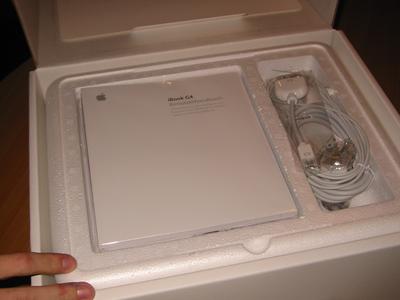
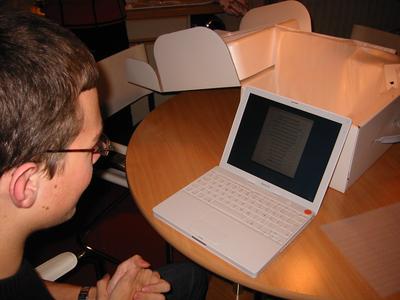
My first iBook
Today, my first ever iBook arrived (I ordered it last Wednesday, if
there wasn’t the weekend in between, I’d have gotten it even faster.),
and so far, it totally kicks ass. I bought the 12.1" one with a
60 GB disk for even more music/code/other cool stuff. :-)
It is just the right size, and the features and look are simply
amazing. And you don’t hear a thing.
I have never used Mac OS X before, but after toying around a bit with
it, it really looks nice and usable (heck, Expose rocks).
So far, I only found on thing that turned be off a bit: The keyboard,
although of good quality has a quite, umm, twist^Winteresting
keylayout. Why the pipe symbol | is Alt-6, for example, someone
really should explain to me…
After reinstalling it for maximum customization (a hint
ThreeDayMonk gave me), I think I’m going
to spend some days to adopt it my working style.
BTW, I called it lilith because my (main) box is dubbed paradise,
and there are nice, medieval paintings where Lilith (mythologically
Adam’s first wife) gives Eva the Apple. :-)
Of course, such an event needs to be documented photographically:


NP: Pearl Jam & Neil Young—Fallen Angel
femtoblog
On ruby-talk, there recently was a thread about the nicest programs
for Ruby signatures. I proposed femtoblog, a tiny CGI blog in only
127 bytes:
puts"Content-type: text/html\n\n<h1>Blog",Dir["*.entry"].sort_by{
|f|-File.mtime(f).to_i}[0,9].map{|f|"<h2>#{IO.read f}<hr>"}
Of course, that code shouldn’t be taken too seriously… heck, I need
to get Nukumi2 out.
NP: Die Roten Rosen—Ihr Kinderlein Kommet
2. Advent
Frohen zweiten Advent euch allen!
Ja, auch den C-Programmiern:
Advent, Advent, 0 Lichtlein brennt.
Erst eins, dann zwei, dann drei, dann vier,
dann steht das Christkind vor der Tür.
Advent, Advent, 1 Lichtlein brennt.
Erst eins, dann zwei, dann drei, dann vier,
dann steht das Christkind vor der Tür.
Advent, Advent, 2 Lichtlein brennt.
Erst eins, dann zwei, dann drei, dann vier,
dann steht das Christkind vor der Tür.
Advent, Advent, 3 Lichtlein brennt.
Erst eins, dann zwei, dann drei, dann vier,
dann steht das Christkind vor der Tür.
Advent, Advent, Segmentation Fault
NP: Die Roten Rosen—I Wish It Could Be Christmas Every Day
Quotes am Donnerstag
Auch mal wieder Zeit:
[Lehrer:] Respekt hab’ ich vor euch gar keinen.
— Das
beruht auf Gegenseitigkeit!
Man hat das ja gesehen, im 3. Reich mit der Zivilcourage — die
hatten ja alle den Schwanz im Arsch.
[meint: eingezogen.]
Der Bundestag ist ein gesetzlicher Feiertag.
Queen Mom hat jeden Tag Gin gegessen.
NP: Ton Steine Scherben—Wir müssen hier raus!